Brand CasesThe Water Footprint of a Fabric
Publication Date:2026-09-23
View:100
Anta Group has always integrated sustainability and social commitment into value chain management. By continuously optimizing operational efficiency across the entire value chain, we encourage suppliers to adopt new manufacturing technologies and production processes, conserving water, energy and raw materials at the source while reducing consumption and waste.
On the supply chain side, Anta encourages and requires suppliers to report water use data and set water consumption optimization targets through industry tools such as IPE and Higg FEM. On the consumer side, Anta uses its Anta Zero Store as a window to communicate sustainability with consumers, offering product series made with water-saving processes to build the brand's sustainable development mindset. To quantify and verify the effectiveness of these water-saving processes, Anta commissioned professional partners to conduct product water footprint assessment and calculation.
The verification was conducted by SGS through a full-process water resource review of two processes — traditional dyeing and micro-water dyeing. The assessment covered cotton knit fabrics in both light and dark colors. The results show that, in the dyeing and finishing stage, the water consumption per ton of fabric produced with the micro-water dyeing process decreased from58.530 m³/tto16.684 m³/tfor light-colored products, a reduction of71.50%; and from75.305 m³/tto17.538 m³/tfor dark-colored cotton knit products, a reduction of 76.71%.
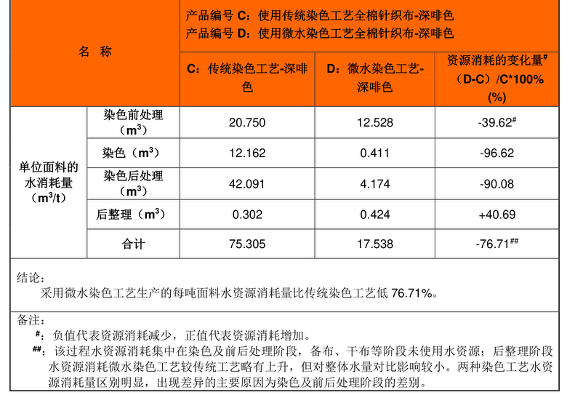
Comparison of water consumption between traditional dyeing and micro-water dyeing processes (SGS verification)
Micro-water dyeing saves nearly 80% of water. This is a green step taken together by Anta and its suppliers.
Source: SGS Report on Anta Resource Efficiency Assessment and Verification (CN20250315001SCM)
(The above content is provided by the brand, and the authenticity of the data is the responsibility of the brand. )