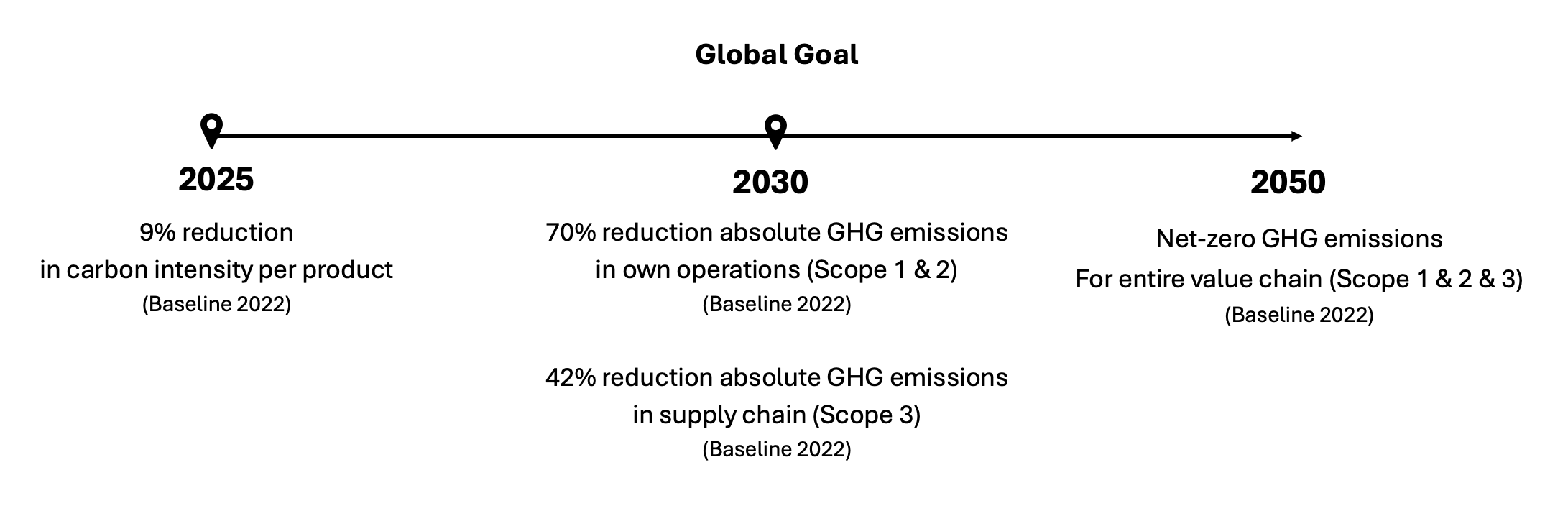
As climate change continues to reshape our world, strengthening the resilience of our business operations and supporting the transition to a low-carbon future are strategic priorities for adidas. In 2025, we published the new adidas Climate Transition Action Plan (CTAP), which emphases our goal: achieving net-zero by 2050. To reach this ambitious goal, we created a clear roadmap, working to reduce carbon emissions both within our own operations and across our supply chain, moving towards net-zero.
At the supply chain level, we are pushing forward by multiple decarbonization actions at the same time:
• Renewable energy (RE) and energy efficiency (EE)
- Renewable energy (RE): We require our strategic Tier 1 and Tier 2 suppliers to use as much renewable electricity as possible, including both on-site and off-site renewable energy. Since 2019, we've been encouraging suppliers to install distributed rooftop solar. By 2025, Chinese suppliers have installed 800,000 m² of rooftop solar, with total capacity of 105 MWp, generating 96,569 MWh annually. At the same time, we've worked with third parties to create green power/certificate guidelines and provide training. By 2025, Chinese suppliers have purchased 255,722 MWh of off-site green electricity and 85,257 GEC. The proportion of green electricity usage has reached 43%, which is quite significant.
- Energy efficiency (EE): We collaborate with our strategic Tier 1 and Tier 2 suppliers to adopt energy-efficient equipment and processes. Our Environmental Good Practices Guidelines (EGPG) provide a comprehensive list of best practices for reducing energy use. We encourage suppliers to periodically conduct energy audits, identify energy-reduction initiatives, and implement them.
• Coal Phase Out
In line with our Climate Transition Action Plan, adidas implemented a dedicated coal phase-out program with Tier 1 and Tier 2 suppliers to replace coal-fueled boilers with lower-carbon energy solutions, such as biomass or natural gas, wherever feasible. By the end of 2025, Chinese suppliers have fully completed the replacement and modification of coal-fueled boilers.
• Suppliers’ SBTi targets
Since 2022, we have been encouraging our strategic suppliers to join the Science-Based Targets initiative (SBTi) and complete their target setting. In 2025, we completed the delivery of the SBTi upskilling program for our suppliers, providing them with the skills needed to identify and quantify their Scope 1, 2, and 3 GHG emissions and to build roadmaps for reducing these emissions.
By implementing decarbonization measures across the value chain. We achieved a 9% reduction in Scope 1-3 product carbon intensity (baseline 2022) and 5% reduction in Scope 3 GHG emissions (baseline 2022) by the end of 2025.
(The above content is provided by the brand, and the authenticity of the data is the responsibility of the brand)